
Download high resolution image [JPG 660.28 KB]
![Download high resolution image [JPG 660.28 KB]](https://www.darlingdowns.health.qld.gov.au/__data/assets/image/0038/492788/20260624-dr-tanvir-kapoor-2-hires.jpg)
A fresh look at an emerging research method could help bring cutting-edge drug and treatment trials to rural and regional communities across Australia.
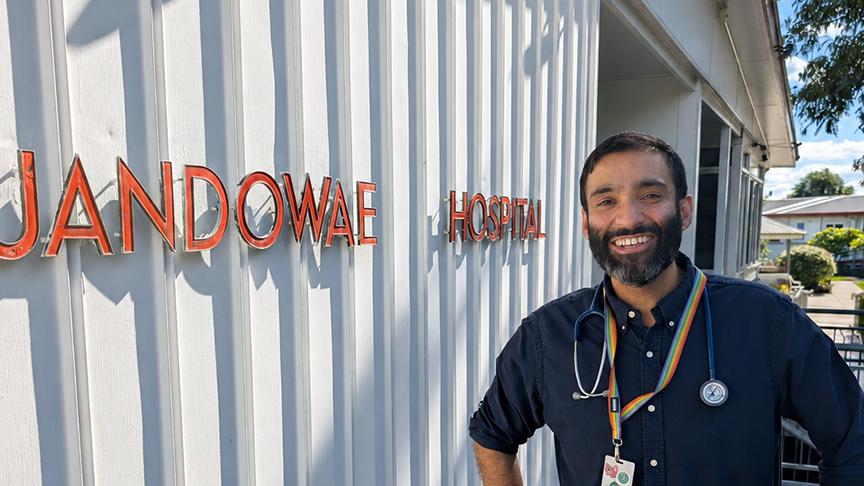
A new paper led by Darling Downs Health Medical Superintendent for Jandowae, Dr Tanvir Kapoor says the use of real-world data, could significantly broaden access to clinical research.
“It means more patients may be able to take part in research without needing to travel long distances or rely on large hospital infrastructure,” Dr Kapoor said.
Dr Kapoor found the use of data could produce similar results to randomised controlled trials – the gold standard in research - and overcome key challenges of such trials in rural areas including lack of logistical support.
With about 90 per cent of clinical trials being conducted in major cities, Dr Kapoor said the work was about making sure rural patients weren’t left behind.
“People in regional and rural areas like the Darling Downs deserve the same access to new treatments and research as those in major cities,”
Darling Downs Health Medical Superintendent for Jandowae, Dr Tanvir Kapoor
“Too often, health research is designed around urban populations, and it doesn’t always reflect the realities of our communities.
“By using observational studies and a method known as target trial emulation, we can make better use of local, real-world data to improve care for our patients.”
Dr Kapoor is applying the research methodology to his own work, looking at whether the use of C-reactive protein testing impacts the transportation of patients from rural hospitals. This research will be presented at the National Rural Health Conference in Adelaide later this year
Darling Downs Health Director of Research, Dr Anna Tynan, said the study highlighted the important role local clinicians play in driving innovation.
“It’s fantastic to see research led right here on the Darling Downs that has the potential to make a real difference for our communities,” Dr Tynan said.
“This work shows that regional health services can lead the way in developing practical solutions that improve access to care and help close the gap between city and country health outcomes.”
The study, completed in collaboration with researchers from across Australia including the University of New South Wales, Flinders Health and Medical Research Institute and the University of Queensland, has been published in the Medical Journal of Australia.